Celebrating an anniversary when you're far apart
4 min
Anniversaries are harder at distance than birthdays. A birthday can be celebrated late. An anniversary is a specific date that means something to exactly two people, and spending it apart has a particular sting: the one day that is about the relationship, spent demonstrating the thing that makes it difficult.
Here is what people in long-distance relationships actually do that works.
Decide what you're marking
Couples who handle distance well tend to be specific about what the day is for. Three common versions:
- The day we met. Good for new-ish relationships, and it ages well.
- The day we made it official. The standard.
- The day we survived. Some couples deliberately mark the hardest month rather than the happiest — the year one of you moved away, the visa refusal, the six weeks of silence. It's an unusual choice and the people who do it swear by it.
Pick one and keep it. Distance already introduces enough ambiguity.
Get the time zones right, on purpose
The most common failure is not forgetting — it's two people each waiting for a "good time to call" and the day evaporating.
Fix it in advance. Name an hour, in both time zones, in writing, a week early. If one of you has to get up at 5am, that person gets to choose what you do.
Things worth doing
Eat the same meal. Both cook the same dish, at the same hour, on video. It is slightly ridiculous and it works, because it produces a shared memory rather than a shared conversation about missing each other.
Rewatch something specific. Not any film — the film. Press play on a count of three.
Write the year down. A letter covering what happened in the last twelve months, what you found hard, what you're looking forward to. Exchange them on the day, read them at the same time.
Record a message rather than typing one. This is the single biggest upgrade available to a long-distance couple, and the least used. Distance strips tone out of everything; you spend months reading each other's flat text and inferring mood. Hearing the actual voice — the laugh, the pause, the thickness when they say your name — puts back the thing the distance took.
Send something physical, early. Post is slow and unreliable across borders. If you want an object there on the day, send it two weeks out and accept it'll arrive whenever it arrives.
Plan the next visit, on the day. Nothing improves morale like a date. Even a provisional one.
Things that don't work
Pretending it's a normal day. Some couples do this to avoid the sadness. It reads as indifference, and the other person almost always notices.
The surprise visit, unless you're certain. It's a wonderful story when it lands and a genuinely bad day when they have an exam, a shift, or a flat full of family.
Comparing yourselves to couples who live together. Different sport.
Messages that work at distance
- "Two years. Most of it on a screen. Still the best decision I've made."
- "I've spent more hours looking at a picture of your face than most people spend looking at the real thing. Worth it."
- "Happy anniversary. The distance is a detail, not the story."
- "Same date, different continent, same answer: you."
- "I miss you in an ordinary, daily, unglamorous way. Happy anniversary."
- "This year was hard and we did it anyway. That counts for more than an easy one would have."
The part nobody mentions
Long-distance relationships are mostly logistics — calendars, flights, time zones, bad wifi. The romance has to be scheduled, which feels wrong to people raised on films where it happens spontaneously.
Scheduled affection is not lesser affection. Turning up on a Tuesday because you said you would, when neither of you is in the mood, is arguably a stronger signal than any grand gesture. An anniversary is just the formal version of that: a date you both agreed to protect.
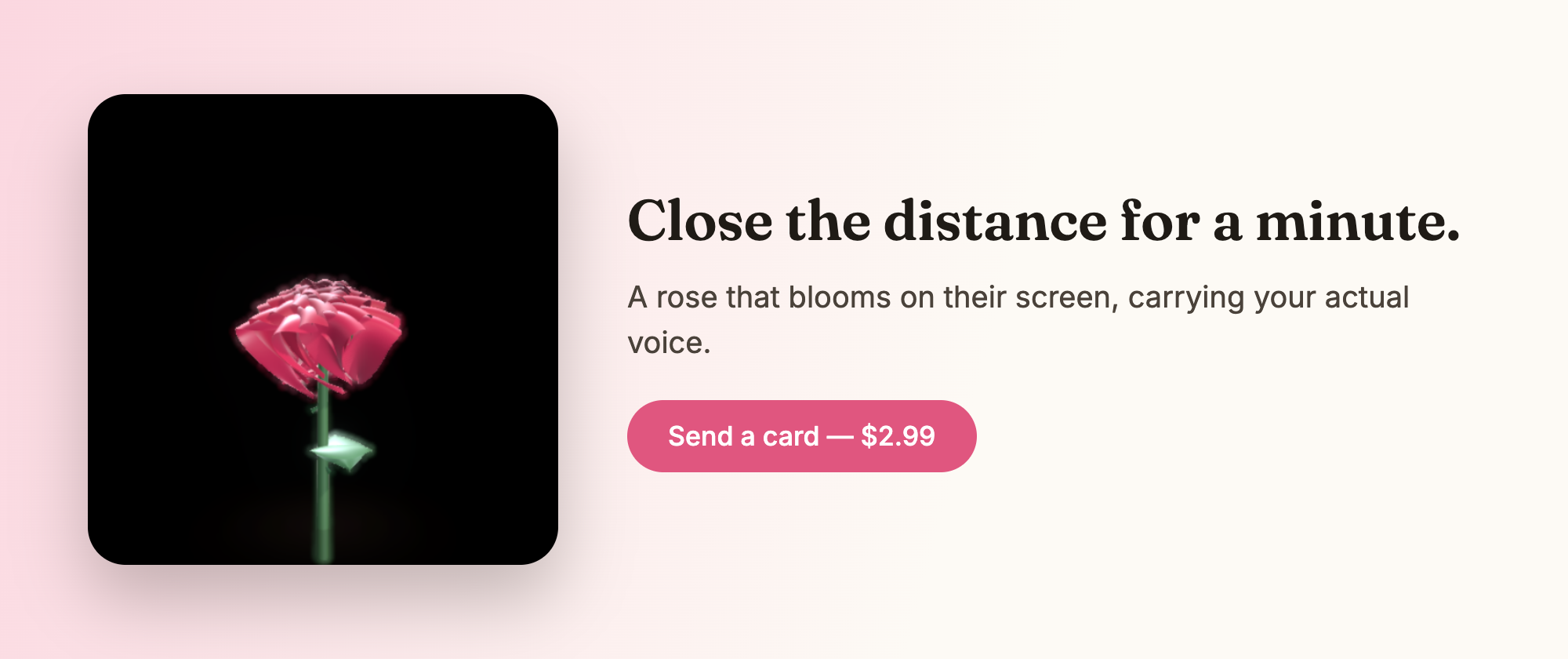
Close the distance for a minute
A rose that blooms on their screen, carrying the voice the distance keeps taking out of everything else.
Make a card — $2.99 — one payment, no account, ready in about two minutes.